In the midst of a war in Iraq, in a time of escalatingglobal terrorism, when civil liberties are disappearingas fast as the ozone layer, when one out of threewomen in the world will be beaten or raped in herlifetime, why write a play about my stomach?Maybe because my stomach is one thing I feel Ihave control over, or maybe because I have hopedthat my stomach is something I could get controlover. Maybe because I see how my stomach has cometo occupy my attention, I see how other women�sstomachs or butts or thighs or hair or skin have cometo occupy their attention, so that we have very littleleft for the war in Iraq�or much else, for that matter.When a group of ethnically diverse, economicallydisadvantaged women in the United States wasrecently asked about the one thing they wouldchange in their lives if they could, the majority ofthese women said they would lose weight. Maybe Iidentify with these women because I have boughtinto the idea that if my stomach were flat, then Iwould be good, and I would be safe. I would be protected.I would be accepted, admired, important,loved. Maybe because for most of my life I have feltwrong, dirty, guilty, and bad, and my stomach isthe carrier, the pouch for all that self-hatred. Maybebecause my stomach has become the repository formy sorrow, my childhood scars, my unfulfilled ambition,my unexpressed rage. Like a toxic dump, it iswhere the explosive trajectories collide�the Judeo-Christian imperative to be good; the patriarchal mandate that women be quiet, be less; the consumer-stateimperative to be better, which is based on the assumptionthat you are born wrong and bad, and thatbeing better always involves spending money, lots ofmoney. Maybe because, as the world rapidly dividesinto fundamentalist camps, reductive sound bites, andpolarizing platitudes, an exploration of my stomachand the life therein has the potential to shatter thesedangerous constraints.
This journey has been different from the one Iundertook in The Vagina Monologues. I was worriedabout vaginas when I began that play. I was worriedabout the shame associated with vaginas and I wasworried about what was happening to vaginas, in thedark. As I talked about vaginas and to vaginas, I becameeven more worried about the onslaught of violencedone to women and their vaginas around theworld.
There was, of course, the great celebration of vaginasas well. Pleasure, discovery, sex, moans, power.I suppose I had this fantasy that after finally cominghome into my vagina, I could relax, get on with life.This was not the case. The deadly self-hatred simplymoved into another part of my body.
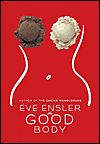
The Good Body began with me and my particularobsession with my �imperfect� stomach. Ihave charted this self-hatred, recorded it, tried tofollow it back to its source. Here, unlike the womenin The Vagina Monologues, I am my own victim,my own perpetrator. Of course, the tools of my selfvictimizationhave been made readily available. Thepattern of the perfect body has been programmedinto me since birth. But whatever the cultural influences and pressures, my preoccupation with myflab, my constant dieting, exercising, worrying, is selfimposed.I pick up the magazines. I buy into theideal. I believe that blond, flat girls have the secret.What is far more frightening than narcissism is thezeal for self-mutilation that is spreading, infectingthe world.
I have been to more than forty countries in thelast six years. I have seen the rampant and insidiouspoisoning: skin-lightening creams sell as fast as toothpaste in Africa and Asia; the mothers of eight-year-oldsin America remove their daughters� ribs so theywill not have to worry about dieting; five-year-olds inManhattan do strict asanas so they won�t embarrasstheir parents in public by being chubby; girls vomitand starve themselves in China and Fiji and everywhere;Korean women remove Asia from their eyelids. . . the list goes on and on.
I have been in a dialogue with my stomach forthe past three years. I have entered my belly�thedark wet underworld�to get at the secrets there. Ihave talked with women in surgical centers in BeverlyHills; on the sensual beaches of Rio de Janeiro;in the gyms of Mumbai, New York, Moscow; in thehectic and crowded beauty salons of Istanbul, SouthAfrica, and Rome. Except for a rare few, the womenI met loathed at least one part of their body. Therewas almost always one part that they longed tochange, that they had a medicine cabinet full ofproducts devoted to transforming or hiding or reducingor straightening or lightening. Just about everywoman believed that if she could just get that partright, everything else would work out. Of course, it isan endless heartbreaking campaign.
Some of the monologues in The Good Body arebased on well-known women like Helen GurleyBrown and Isabella Rossellini. Those monologues,which grew out of a series of conversations with eachof these fascinating women, are not recorded interviews,but interpretations of the lives they offeredme. Some of the other characters are based on reallives, real stories. Many are invented.
This play is my prayer, my attempt to analyze themechanisms of our imprisonment, to break free sothat we may spend more time running the worldthan running away from it; so that we may be consumedby the sorrow of the world rather than consumingto avoid that sorrow and suffering. This playis an expression of my hope, my desire, that we willall refuse to be Barbie, that we will say no to the lossof the particular, whether it be to a voluptuous womanin a silk sari, or a woman with defining lines of characterin her face, or a distinguishing nose, or olivetonedskin, or wild curly hair.
I am stepping off the capitalist treadmill. I amgoing to take a deep breath and find a way to survivenot being flat or perfect. I am inviting you to join me,to stop trying to be anything, anyone other than whoyou are. I was moved by women in Africa who livedclose to the earth and didn�t understand what it meantto not love their body. I was lifted by older women inIndia who celebrated their roundness. I was inspiredby Marion Woodman, a great Jungian analyst, whogave me confidence to trust what I know. She hassaid that �instead of transcending ourselves, we mustmove into ourselves.�Tell the image makers and magazine sellers andthe plastic surgeons that you are not afraid. Thatwhat you fear the most is the death of imaginationand originality and metaphor and passion. Then bebold and LOVE YOUR BODY. STOP FIXING IT. Itwas never broken.










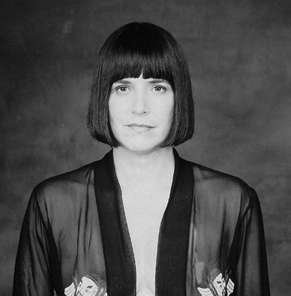 EVE ENSLER is an internationally acclaimed playwright whose previous works for the stage include Floating Rhonda and the Glue Man, Lemonade, Necessary Targets, and The Vagina Monologues, for which she received an Obie Award. Ensler is the founder and artistic director of V-Day (