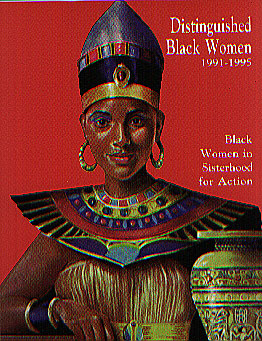
| Excerpts from the Preface, written by Verna S. Cook, Ph.D, National President of BISA "During our 15 years of operating, BISA has saluted 181 black women through its annual calendar. In 1986 and 1990, BISA published its first two books, Distinguished Black Women 1981-1985, Volume I and Distinguished Black Women 1986-1990, Volume II. Those books included the 121 women that BISA had honored in its first ten annual calendars. Today, the same as in 1986 and 1990, BISA is unswerving in its commitment to chronicle and herald the outstanding accomplishments of black women in action, past and present. The women chosen for the third book continue to express BISA's commitment. All of BISA's distinguished women serve as role models and mentors to members, scholarship students and youth of all ages. These black women help to empower us. It is impossible to overestimate the contributions and inspiration of these women to our livelihood. BISA's annual calendars, posters and books are designed to educate and inspire our young people for excellence through continous achievement. Beyond all that, we want to celebrate black women, our heritage, our forebears. They are the perpetuators of black heritage. These women, selected from among many, are maps of excellence. It is through their support of our mission, goals, and programs that we were able to market products (calendars, posters, books and poems) that provide the primary source of funding for the national scholarship assistance program...BISA proudly acknowledges that distinguished Black women were here yesterday; they are here today and they will be here tomorrow. "
Prologue, written by Charlotte K. Brooks, Ph.D Alice Walker speaks wisely in In Search of our Mothers' Garden when she writes , 'The world is not good enough - we must make it better. But it is a great time to be a woman. A wonderful time to be a black woman...because the past is studded with sisters who, in their time, shone like gold.' And BISA celebrated these sisters, these black women, in yearly calendars and books published at five-year intervals for fifteen years. For the first book in the series, representing the years 1981-1985, I wrote about black women in the world; in the second, for 1986-1990, I chose to use black women in the universe as my theme. In this third book, 1991-1995, I want to move back from the universe and the world to a smaller sphere where black women have always made a difference - their communities. These last five calendars include many women who have had great influence in the various communities which they represent. And by "communities" I do not mean merely a geographic neighborhood -, a place upon a map. In addition to that important kind of community - which I do include in this essay - other kinds of communities which I wish to cite are the communities of the arts, the intellect (inclusive of education and science) and politics. The community of artists is a very large one in which black women have always played outstanding roles. Among these are performing artists Jessye Norman, operatic and concert diva; and Ella Fitzgerald, "First Lady of Song". Debbie Allen, actress and choreographer, is an inspiration to other talented young women. Rita Dove had tremendous influence upon the community of writers as she invited authors, including poets, to appear on programs during her two years as Poet Laureate Consultant at the Library of Congress. Also in the writing community are Margaret Walker Alexander and Alice Walker, both novelists, essayists and poets. Elizabeth Catlett, sculptor, beautifully represents the visual arts. A key community in the black world is the intellectual one, including schools, universities and the disciplines taught there. Dorothy Porter Wesley, librarian, archivist and bibliographer, contributed much to this community, as do Vera White and Princess Dupont Whitfield, principals of award-winning Junior high schools, and Niara Sudarkasa, president of the formally all male Lincoln University. Science, one of the intellectual disciplines, embraces both astronaut Mae Jemison and former Surgeon General M. Joycelyn Elders. I have chosen last the political community, which has such a powerful influence upon all the others. Queen Njinga of the African land now called Angola, inherited her throne and ruled from 1582-1663, successfully protecting her people from Portuguese invaders. Hazel O'Leary, Secretary of Energy appointed by President Clinton, declassified fifty years of cold war secrecy about U.S. nuclear weapons programs. Elected black women include Senator Carol Moseley-Braun of Illinois, and congresswoman Carrie Meek of Florida and Cardiss Collins of Illinois. These black women, who inherited or were appointed to or elected to their powerful positions, cut across a number of other communities as they influence legislation and funding for urban and rural neighbors, the arts, and the libraries, schools and universities of this nation. Again, Alice Walker speaks prophetically in In Search of our Mothers' Gardens: 'And I thought of the mountain work black women must do ... we must work as if we are the last generation capable of work.' The black women described in this book are aware of the mountain of work they must do. And they are doing it."
Additional BISA Products: - Distinguished Black Women 1991-1995 - Vol. 3
- Distinguished Black Women 1986-1990 - Vol. 2
- Distinguished Black Women 16th Annual Scholarship Calendar 1996
- Poster - Hatshepsut
- Poster - Njinga
- Poem - Challenge of Black Women's Heritage
- Speech - "I Live"
Funds from the sale of Distinguished Black Women Volume III and all of the above products help to support 37 students at the following predominantly Black Colleges and Universities across America, and the Washington, DC metropolitan area: - Bennett College
- Bethune-Cookman
- Bishop State College
- Chicago State University
- Delaware State University
- Fisk University
- Grambling State University
- Hampton University
- Lincoln University
- Medgar Evers College
- Morris Brown College
- Morgan State University
- Philander Smith College
- Texas Southern University
- Tougaloo College
| BISA welcomes new members, volunteers, as well as mentors to our students at the different colleges and universities that participate in our programs. An organization of Black Women whose purposes are exclusively educational and charitable. | | |